
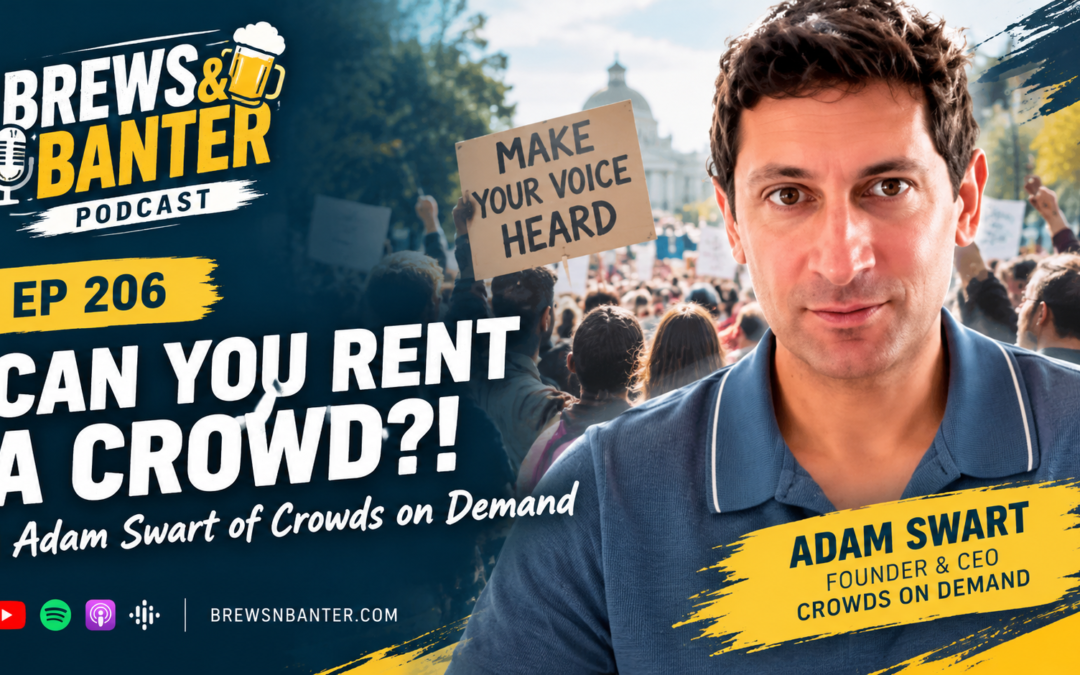
Ep 206: Can You Rent a Crowd?! | Adam Swart of Crowds on Demand
What do you mean you can actually hire a crowd?! 🍻
This week on Brews & Banter, Frank and Roman welcome Adam Swart, founder and CEO of Crowds on Demand, for a fascinating conversation about one of the most unusual businesses you might ever hear about. From organizing peaceful demonstrations and publicity stunts to helping businesses attract attention and supporting advocacy campaigns, Adam explains how his company brings people together to make an impact.
But how does it all work? Who hires a crowd, how are participants selected, and what does it take to turn a gathering into a successful campaign? Frank and Roman had plenty of questions, and Adam was ready with answers, surprising stories, and insights into the business of public attention.
What Is Crowds on Demand?
Adam Swart describes Crowds on Demand as a company that organizes protests, demonstrations, public relations stunts, and advocacy campaigns. The company also helps clients arrange audiences for product launches, promotional events, and other occasions where having people physically present can make a difference.
As Adam explains during the episode, the idea is not simply to put people in a location. It is to help clients attract attention and create opportunities for their message, product, or cause to reach a wider audience.
Imagine walking past a restaurant with no customers inside, then noticing another restaurant with a line out the door. You might be more curious about the busy restaurant. That same principle of attracting attention is part of what Adam says his company offers.
However, he makes an important distinction: the crowd can help get people to notice a campaign, but the product, message, or cause still has to stand on its own merits.
How Do You Hire a Crowd?
One of the biggest questions Frank and Roman explore is how a paid crowd actually works.
Adam explains that clients may request a specific number of people for an event, demonstration, city council meeting, product launch, or promotional activity. The requirements depend on what the client wants to accomplish.
For political and advocacy events, Adam says participants are interviewed to confirm that they support the issue and are willing to participate according to the company’s principles of lawful, peaceful, and respectful advocacy. According to him, participants are compensated for their time rather than paid to pretend to hold beliefs that contradict their own.
The company also considers the difficulty of each assignment when determining costs. Factors can include the location, weather, hours involved, responsibilities, the number of participants needed, and the complexity of the event.
A promotional audience in a major city may be easier to organize than a specialized advocacy gathering in a remote location. More complicated events can require additional planning, supervision, and coordination.
It’s a whole different side of event planning—and one that raises plenty of interesting questions.
From Product Launches to Public Demonstrations
Crowds on Demand isn’t limited to political protests. As Adam explains, the company can help with a variety of events and campaigns.
Depending on the client’s goals, those activities may include:
- Product launches and promotions: Organizing audiences and gatherings that attract attention to a new product or business.
- Public relations stunts: Creating attention-grabbing events designed to generate public interest.
- Peaceful demonstrations: Helping organize participants around issues they support.
- Advocacy campaigns: Bringing people together to raise awareness and encourage action on a particular issue.
- Special events: Providing attendees or carefully selected participants for occasions that require particular roles or arrangements.
Adam also discusses how campaigns can be customized to meet a client’s needs and budget. Some events require only a group of attendees, while others need more detailed coordination, specific clothing, assigned roles, or on-site supervision.
The conversation reveals just how much planning can happen behind what the public sees as a simple crowd.
The Wedding Story You Won’t Expect
Of course, Frank and Roman couldn’t resist taking the conversation in a few unexpected directions.
One of the episode’s most memorable moments comes when the hosts ask Adam whether his company has ever been hired to provide guests for a wedding.
The answer is yes—and the story gets increasingly entertaining.
Adam recounts an unusual wedding assignment in which his company was asked to provide not only friends for the bride but also family members, including a father of the bride, on short notice. The participants had to prepare convincing backstories in case the actual family asked questions.
The team prepared for every possibility, only to discover that the visiting family members did not speak English.
It is exactly the kind of unexpected story that makes this episode of Brews & Banter so entertaining. It also illustrates how detailed some assignments can become when a client wants an event to look a particular way.
Why Vetting and Safety Matter
With a business involving public gatherings, demonstrations, and large groups of people, safety is an important subject.
Adam emphasizes that Crowds on Demand screens both its clients and its participants. He explains that the company considers the nature of an event and the possibility of tension before agreeing to take on an assignment.
If an event appears likely to create a dangerous confrontation, Adam says he may recommend an alternative or decline the engagement. For certain situations, he also insists on having security personnel present.
He explains that the level of supervision depends on the event’s sensitivity, complexity, and requirements. A group attending a presentation is different from a demonstration involving a potentially tense public situation.
The discussion offers a look at the responsibilities involved in organizing public events and why careful planning matters.
Can a Crowd Really Change Public Opinion?
One of the deeper questions raised in this episode is whether paid participation makes a demonstration or campaign less authentic.
Frank and Roman openly explore the difference between attending an event because you believe in a cause and attending because there is financial compensation. Adam argues that people can have different motivations for participating while still genuinely supporting the issue.
He also explains that financial incentives can make it possible for people with jobs, families, and other responsibilities to devote time to an event they care about.
The conversation doesn’t avoid the difficult questions. Instead, it explores the relationship between motivation, public participation, organized campaigns, and the way people interpret what they see.
That makes this episode more than a discussion about an unusual business. It is also a conversation about how public attention is created and how audiences judge the events unfolding in front of them.
The Power of Public Attention in a Digital World
Another interesting theme is the continuing importance of in-person events in an increasingly digital world.
Adam believes that online spaces have become so crowded with content that real-world gatherings can still make a strong impression. A demonstration, public event, or well-planned publicity stunt can create a visible moment that people notice and discuss.
During the conversation, he also discusses the company’s involvement in advocacy efforts, including the Delete Facebook campaign, which he describes as one of his proudest accomplishments.
The broader lesson is that visibility can help a cause or campaign reach people who might otherwise never encounter it. But attention alone is not the same as persuasion. A campaign still needs a message that connects with its audience.
Adam Swart’s Biggest Lesson: Know Who Has the Power to Help
Toward the end of the episode, Adam shares an insight that goes beyond organizing crowds.
He explains that much of his work involves strategy: identifying who has the authority to make a decision, understanding what matters to that person, and figuring out how to persuade them to take action.
His advice is surprisingly practical. Instead of directing frustration at someone who cannot solve a problem, identify the person who actually has the power to help. Then explain the issue in a way that connects with their priorities.
Adam says this approach applies to advocacy campaigns, business negotiations, public pressure, and everyday situations.
It’s a useful reminder that making noise is not necessarily the same as making progress. Knowing your audience, choosing the right approach, and communicating effectively can make all the difference.
A Conversation Full of Surprises
From the mechanics of hiring a crowd to the logistics of peaceful demonstrations, unusual wedding assignments, and the strategy behind public pressure, Episode 206 covers far more ground than its title might suggest.
Frank and Roman bring their curiosity and trademark banter to the conversation, while Adam offers an inside look at a business that many listeners may never have considered before.
Whether you are interested in entrepreneurship, marketing, public relations, advocacy, or simply enjoy hearing about businesses that operate outside the ordinary, this episode offers plenty to think about.
And yes, you might find yourself looking at the next crowd you see a little differently.
Watch or Listen to Episode 206
Want to hear the full conversation with Adam Swart? Tune in to Brews & Banter, Episode 206: Can You Rent a Crowd?!
Learn more about the guest and the show:
- Crowds on Demand: https://crowdsondemand.com/
- Brews & Banter: https://brewsnbanter.com
Thanks for joining Frank and Roman for another conversation filled with unexpected insights, interesting questions, and classic Brews & Banter humor. 🍻
What do you think? Does hiring a crowd make a campaign more effective, or does it change how you view the message? Share your thoughts and join the conversation!